Jak vzniká pohyblivá hračka: od nápadu po balíček
Jak to, že se figurka hýbe, když je vytištěná vcelku? Pohled do naší dílny v Janovicích nad Úhlavou, od prvního nápadu po zabalený balíček.
At craft fairs, people ask us pretty much the same thing all the time. How can it move when it's printed in one piece? And how long does it take?
So we thought we'd write it all down.
First comes the idea, and it's usually not a good one
Most of the ideas we come up with go nowhere. Either they can't be printed, or they can be printed but fall apart the first time you bend them, or they just look odd.
Before an idea turns into something we can sell, it usually goes through several rounds of tweaks. Not because we're fussy about it, but because it simply doesn't work until then.
How a figure gets to move
This is the part people are most curious about.
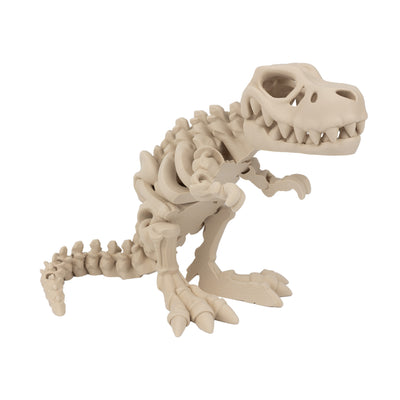
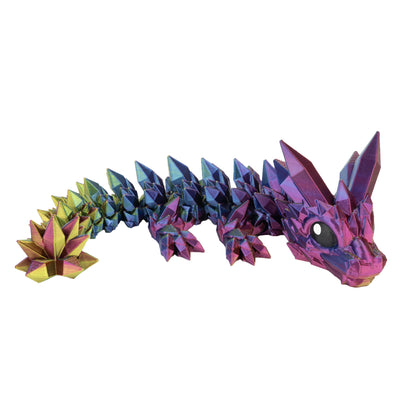
The joint isn't made of two parts that snap together. It's printed in one go, with just a tiny gap left between the segments. Small enough that the material doesn't fuse, yet precise enough for the joint to hold without wobbling.
If the gap is too big, the figure is wobbly and won't hold a pose. If it's too small, the segments fuse during printing and you end up with a rigid lump of plastic.
Fine-tuning this is work nobody sees. And it varies with the color of the material, the size of the figure and how many joints it has.
The printing itself takes longer than you'd think
A small keychain takes a few dozen minutes. A bigger dragon takes several hours. Winged baby dragons, whose wings move too, are the slowest to print because they need a higher resolution.
Our printers run practically nonstop. And every now and then a print fails after five hours and we start over. That's part of the job.
The material
We print with PLA, short for polylactic acid. It's made from renewable sources, most often corn or potato starch, and it's biodegradable.
For a children's toy, it has two properties that really matter. It's non-toxic and BPA-free.
And the color is right there in the material we print with. Holographic versions change shade depending on the angle of the light, and glow-in-the-dark ones shine in the dark after charging in the light.
What happens after printing
The figure comes off the printer, but it isn't finished yet.
We take it off the build plate, clean up the small imperfections that come from printing, and check that every joint works the way it should. If not, the piece gets set aside.
It's handwork, and there's more of it on every piece than you'd expect. It's also the reason why two figures in the same color are never exactly alike.
Certification
This is the part nobody talks about, but it took us more time than anything else.
For a product to be sold as a children's toy, it has to pass tests under European standards. They test the shape, the flammability and how much of various substances the material releases when a child puts it in their mouth.
And because every colorant is different chemistry, it isn't just one sample that gets tested, but every color separately.
Most 3D printed figures on the market haven't been through this, which is why they're sold as decorations with a warning that they aren't for children. We have CE certification, and our toys are suitable for children aged 3 and up.
And then the parcel
We pack it, add a little card and off it goes to the post office. We ship most orders so they arrive within two or three days.
When you open the box, you're holding something that was made a few hundred kilometers from you, in a workshop where everyone knows each other by name. That's probably the main thing we wanted to say.
Prev post
Proč je kapybara tak populární? Příběh nejklidnějšího zvířete internetu
Updated on 11 October 2026
Next post
Dárek pro holku 6 až 10 let, který nemusí být růžový
Updated on 11 October 2026