Are 3D printed toys safe? What the CE mark really means
Většina 3D tištěných figurek se prodává jako dekorace s poznámkou, že pro děti nejsou. My jsme šli druhou cestou a trvalo to o dost dýl, než jsme čekali. Tady je, co za tím stojí.
Search for "3D printed dragon" today and you will find dozens of sellers. But try reading any of their product descriptions to the end. Most of them contain one of these lines:
"This product is not a toy."
"Not intended for children."
"Suitable from 8 years."
"For decorative purposes only."
That is not a formality or a lawyer being careful. It means the product never went through what it has to go through to be sold as a toy for children.
We decided to take the other route. It took us considerably longer than we expected, and there were moments when we asked ourselves whether it was worth it. Today we know it was. Because we can write a sentence most of our competitors are not allowed to write: our toys are certified for children from 3 years.
This article is about what stands behind that sentence. We are not trying to boast, we simply think you have a right to know what separates a safe toy from a figure that only looks like one.
What the CE mark means and what it does not
You see the letters CE on packaging every day. Few people know what they actually mean, and it is worth clearing up, because it gets confused rather often.
CE is not a quality label. It is not an award or a distinction. It is a declaration by the manufacturer that the product meets all legal requirements of the European Union and that this can be demonstrated.
The difference matters. The manufacturer applies the mark themselves, but they are liable for it. They must hold technical documentation, test results and a declaration of conformity, and the trade inspection authority can ask for them at any time. Anyone who does not have them is off the market.
That is exactly why a lot of sellers of 3D printed figures prefer to avoid certification. Writing "not a toy" takes ten seconds. Passing certification does not.
So who oversees toys in Europe
The rules are set by the European Union. Until this year, Directive 2009/48/EC on the safety of toys applied, implemented in the Czech Republic through Government Regulation No. 86/2011 Coll.
The specific limits, values and test procedures are laid down by the EN 71 standard. It is divided into several parts, each covering a different aspect of safety.
What a toy has to pass
Put simply, testing happens on three levels. Each has its own part of the standard.
Mechanical and physical properties (EN 71-1)
This is about shape. Whether the toy has sharp edges or points, whether a piece can be detached that a child could swallow, and whether it survives what children actually do with it.
For toys aimed at the youngest children, the small parts test matters most. There is a standardised cylinder that roughly corresponds to the throat of a small child. Anything that fits inside it can choke a child.
This is where most 3D printed figures fail. An articulated body has dozens of links and it must be certain that not a single one comes loose.
Flammability (EN 71-2)
This tests how the material behaves near fire. Whether it burns, how fast and whether the flame spreads. Nobody wants a toy that starts a fire at home.
Chemistry and migration of elements (EN 71-3)
This part interests parents most, and rightly so. It tests how much of a hazardous substance is released from the material when a child puts it in their mouth. And they will put it there, there is no point pretending otherwise.
The focus is on heavy metals: lead, cadmium, mercury, chromium, arsenic and others. Each has a limit that must not be exceeded.
And now the part almost nobody knows: it depends on the colour. Every pigment is different chemistry. A material that passes in white may not pass in purple. So certifying one shade says nothing about the rest.
That is exactly why it took us so long. We did not send one sample for testing, but every colour and every shape you will find in our shop.
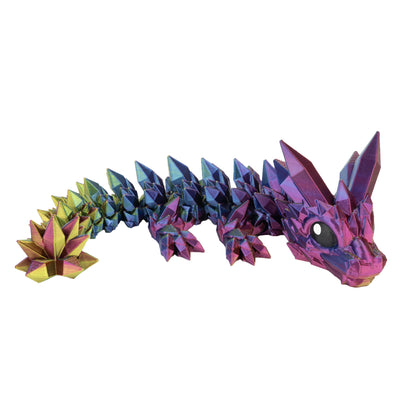
Take a look at our baby dragons, for example, available in holographic, rainbow and glow-in-the-dark finishes.
What our toys are made of
We print from PLA, short for polylactic acid. It is made from renewable sources, most often corn or potato starch, and it is biodegradable.
For a children's toy it has two properties that matter. It is non-toxic and free of BPA, or bisphenol A, a substance everyone is trying to eliminate from toys today.
And then there is the colour. We do not paint or spray our toys. The colour is in the material we print with, so there is nothing to scratch off, peel or lick away. For something a child carries around in their mouth half the time, that is no small thing.
Shape and age limit
Certification is not only about chemistry. Shape matters just as much.
We design our figures so there are no points or edges a child could cut themselves on. The articulated body comes out of the printer in one piece, so there are no screws, clips or glued joints that could work loose.
The result is a toy from 3 years. We set that limit as our goal right at the start, because that is exactly the age when children play the most and the hardest.
Do not give our toys to children under three. It is not a formality — smaller pieces fall into the small parts category and the choking risk is real.
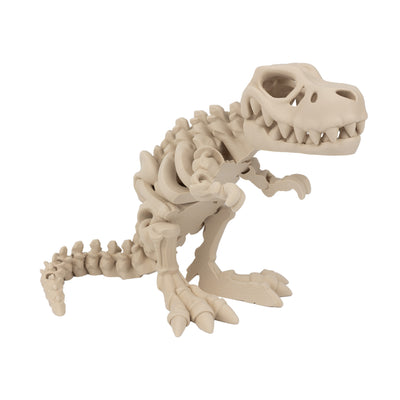
Our customers order articulated animals and dragons most often.
What changes this year
European rules are changing right now. It mostly concerns us manufacturers, but it is only fair that you know about it too.
From 1 January 2026, the new EU Toy Safety Regulation No. 2025/2509 applies, replacing the previous directive. Full effect comes after a transition period, from 1 August 2030.
There are two key changes.
Stricter chemistry. On top of the existing ban on carcinogenic and mutagenic substances comes a ban on endocrine disruptors, substances harmful to the respiratory system and skin, and the PFAS and bisphenol groups.
Digital product passport. Every toy placed on the EU market will need a digital passport with a QR code, through which anyone, parents included, can verify conformity data and safety test results.
For us this changes little. There are no PFAS or bisphenols in our material and our certification is done. We will prepare the digital passport well ahead of time, not at the last minute.
We mention it mainly because it will make life considerably harder for importers of cheap toys from outside Europe. And that is good news for everyone.
How to check for yourself
You do not have to take our word for it. Next time you are choosing any toy, go through these three things.
Look for the CE mark on the product or the packaging. If it is not there, it is not a toy under European rules.
Read the description to the end. Lines like "not intended for children" or "decoration only" are a clear signal. The seller is telling you they have no certification.
Ask for the declaration of conformity. Anyone who has one will gladly send it. Anyone making excuses usually does not.
Why this matters so much to us
We are a small Czech workshop. We could have made it easier on ourselves, written "decoration, not a toy" on our figures and carried on selling. Nobody would have said a word.
But it would have missed the point. We make things that bend, twist and pose, and that hold up when they are treated like a toy. We wanted children to actually play with them, not to have them sit on a shelf under a do-not-touch sign.
We made you a Czech toy you do not have to think twice about. The ideal toy for boys and girls alike, one you can put in a three-year-old's hands without a question mark in the back of your mind.
That is the whole reason we went through certification.
You will find our full range in the Dragon Lair and among the animals.
Any questions about materials or certification? Write to us at contact@wygly.com, we are happy to answer.
Prev post
Dítě chce zvíře a doma to nejde. Co s tím?
Updated on 11 October 2026
Next post
Dítě chce zvíře a doma to nejde. Co s tím?
Updated on 11 October 2026